Outsourced industrial laundry doesn’t run on a single billing model. The contract with each client — hotel, food industry, mining operation, facility services provider, industrial cafeteria — depends on volume, linen profile, order predictability, and client maturity. The three models that show up in practice:
- Per kg processed (volume)
- Per piece (unit)
- Fixed monthly fee (subscription)
Each one has a different margin structure, risk exposure, and operational footprint. This article covers when to use each model and how to combine more than one within the same client.
Model 1: per-kg billing
The operation weighs what enters the dirty area, weighs what leaves the clean area, and bills per kg processed (usually by clean weight).
When to use:
- Clients with predictable, high volume (>20 ton/month) — food industry, mid- to large-sized hospitality, meatpacking plants
- Homogeneous linen (towels, hotel sheets, industrial rags — little variation per piece)
- Clients who tolerate small monthly variation
Typical structure:
- Price per kg + contracted soiling index table (e.g., 10%)
- Regulatory tolerance of ±30% validated per collection
- Monthly billing on accumulated volume
Risk:
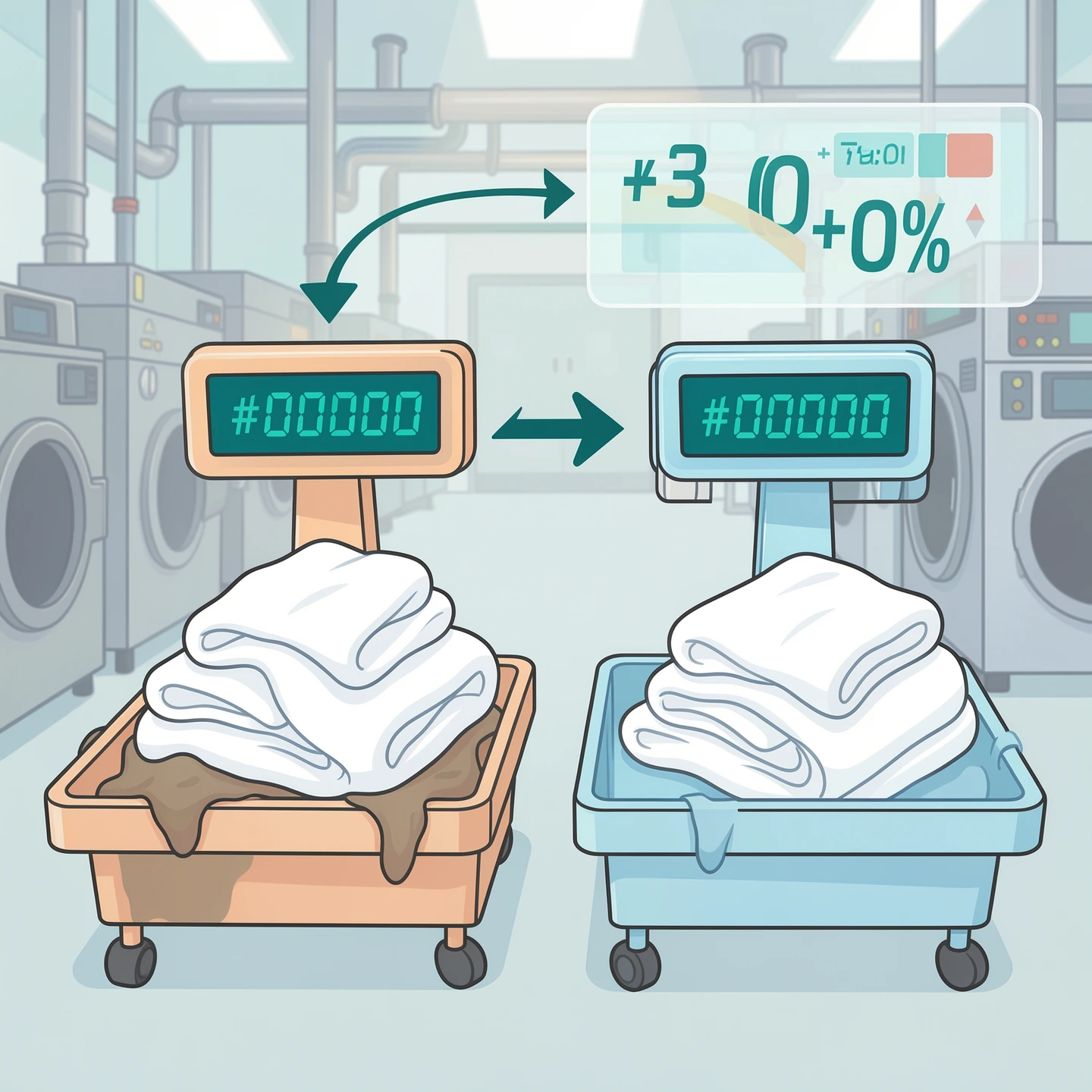
- Weight disputes between the laundry and the client. Industrial linen can arrive with grease, chemical residue, moisture, or wastewater — actual soiling varies. Without a digital record of both weigh-ins (dirty area + clean area), the client pushes back and the laundry silently concedes 5–15% of revenue.
- Without dual weighing with timestamps, the per-kg model loses money every month.
How Cleanifly handles it: weigh-ins in both the dirty and clean areas are recorded with operator and timestamp. Actual soiling is calculated and compared against the contracted value. When the client pushes back, the answer is the screen — not a debate.
Model 2: per-piece billing
Billing per unit of linen processed, usually with a price table that varies by item type (production uniform vs. NR-rated coverall (Brazilian occupational safety standard) vs. lab coat vs. kitchen kit).
When to use:
- Heterogeneous linen with items of different value — this is the typical use case in industrial laundry
- Clients with uniforms or PPE tracked per worker (mining, heavy mechanical, NR-10 electrical PPE, chemical industry)
- Hospitality laundry handling mixed guest items (sheets, bathrobes, bath towels, table linens)
- Clients who want predictable cost per item processed
Typical structure:
- Price table per item type, date-versioned
- Count recorded at collection (or at intake check)
- Billing by quantity × price
Risk:
- An outdated price table creates invoice disputes
- A mid-month price change can rewrite past invoices if the system doesn’t version correctly
How Cleanifly handles it: a date-versioned pricing table — when you change an item’s price today, last month’s invoice keeps the old price. Immutable history. Collection recorded in the moment, no rework.
Model 3: fixed monthly fee
A flat monthly charge with a contracted maximum volume. Above the cap, there’s an additional table or a renegotiation.
When to use:
- Small/medium hotels with stable, well-understood volume
- Small industrial clients with full predictability (workshops, offices with uniforms, restaurant chains)
- In-house laundry of a hospitality group or facility services billing per unit
- Premium clients who want full budget predictability
Typical structure:
- Fixed monthly fee
- Volume cap (e.g., up to 5 ton/month or 8,000 pieces/month)
- Overage clause above the cap
- Annual adjustment
Risk:
- Actual volume exceeds the cap and the laundry processes the surplus without charging the difference
- The client reduces volume but keeps paying the fixed fee (the relationship gets tense)
- Without a real dashboard of consumption vs. cap, the problem only surfaces at year-end
How Cleanifly handles it: the operations dashboard shows collected volume vs. contracted cap in real time. Alerts fire before the cap is exceeded. The commercial decision (charge overage or renegotiate) happens in time, not at the annual close.
Combining models within the same client
Mature laundries often combine two models in the same contract. A practical example in an industrial account:
- Standard production uniforms billed per kg (high volume, low unit value)
- PPE tracked per worker (NR-rated coverall, specialty pants, technical lab coat) billed per piece (low volume, high unit value, controlled lifecycle)
- Scheduled extra pickups with a fixed surcharge per call
This hybrid model is painful in a spreadsheet. In software it’s configuration — three parallel contracts with the same client, summed on the invoice.
How Cleanifly handles all three
The three models run on the same system, with the same client, at the same time:
- Contracts and billing: kg + per-piece + fixed fee configurable per client. Date-versioned pricing table. A price change today doesn’t rewrite past invoices.
- Multiple invoices per month: some clients close bi-weekly, others monthly. The system generates multiple invoices within the same period.
- PDF and XLSX export: every invoice is built from the weighing and contract data, with no manual entry.
- Retrievable history: an invoice from six months ago is searchable, with the prices and parameters in effect on that date.
Next step
If your current system forces a single billing model and you’re losing commercial flexibility, book a demo. We’ll show you how to configure all three models within the same client, in 30 minutes, using the contracts you already run today.
For more depth, see:
- Comparison: notebook vs. spreadsheet vs. Cleanifly — eight concrete scenarios
- Product page — overview of the modules
- Pricing page — how the investment is structured