
Four systems. One invoice. Three hours to close.
Operations in a spreadsheet. RFID in another tool. Billing in a legacy system. Driver in a notebook. Whoever closes the month has to reconcile by hand — and the customer gets the invoice on the 10th.

Centralize collections, traceability, contracts, billing, logistics, and indicators in one connected flow.
Operations in a spreadsheet. RFID in another tool. Billing in a legacy system. Driver in a notebook. Whoever closes the month has to reconcile by hand — and the customer gets the invoice on the 10th.
Digital collection in the morning, manual check in the afternoon, invoice at month-end. Somewhere along that chain, weight becomes a dispute. And a weight dispute becomes a meeting nobody wanted to have.
Volume in operations, margin in finance, SLA in the manager's tracker. Monday's meeting turns into cross-referencing files — not making decisions.
Collection software, an RFID spreadsheet, a separate billing system, the driver's notebook. Each was yesterday's solution. Today they're four sources of rework.
Six connected pillars. Data enters once at collection and flows through the whole operation — no cross-referencing files, no re-typing.
Tablet in the truck. Digital manifest signed on the spot, linked to the customer's contract.
Every collection, weight, and cycle recorded with date, operator, and machine. The auditor asks, the system answers.
Kg, pieces, or fixed rate within the same customer. Price tables versioned by date — a new price never rewrites a past invoice.
Collection and weighing data becomes an invoice. PDF and XLSX the same day, no typing, no reconciliation.
Routes, drivers, and deliveries in the same system. Scheduled or ad-hoc, always tracked with timestamp and operator.
Collected vs. delivered volume, soil index by contract, margin by customer. Real-time, no spreadsheets.
Real results from operations that traded notebooks for a system.
Today we can't picture the laundry running without the system.
Honestly, I expected the rollout to be dull and complicated, but in one week it was implemented and working. What impressed us most was that our customers now follow everything through the system in real time. My team became fans — especially the critical-area staff who no longer have to scribble weights into notepads.
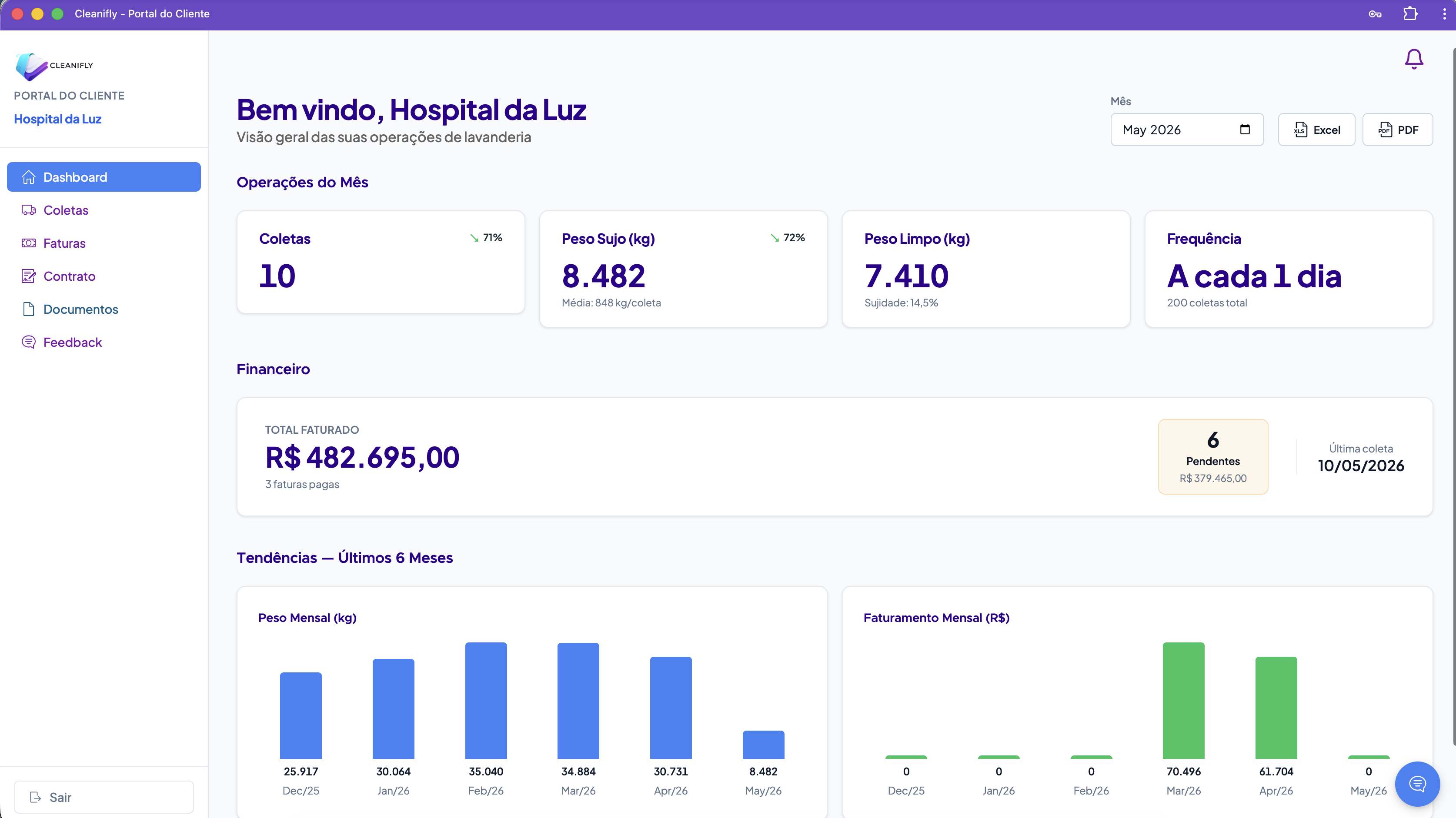
Customers see collections, deliveries, invoices, and contract in the portal — in real time, mobile-responsive. Your team gets out of customer-support mode and back to operations.
Collections in progress, recorded weight, this month's invoice, current contract. The customer sees what your operation is doing now — not tomorrow.
Customer logs a complaint, compliment, or request through the portal — traceable, with date, owner, and history. Not a loose WhatsApp thread.
Runs as an app on the hospital manager's phone (PWA). Notifications for completed collections, invoice available, pending items.
The hospital customer only sees their own data. Granular permissions by role (IT, finance, hospitality, infection control) — you decide who sees what.
Outsourced and in-house hospital operations processing 50–500 tons/month. Configurable tolerance, per-piece tracking, native customer portal for the hospital.
Tender requirements, audit, and month-end close in the same system.
Processing of uniforms and PPE. Per-employee tracking, segregation by contracting company, three billing models within the same customer.
Proof of washing and return per employee. Documentation that holds up under labor audits.
Hotels and resorts with mixed demand: linen by weight, guest items by unit. Seasonal peaks and check-out turnaround.
Hybrid billing (kg + piece) within the same customer, with price tables versioned by date.
Cleanifly imports your spreadsheet history in bulk. Tomorrow's collection goes straight into the system — yesterday's history stays preserved.
Direct answers to the 5 questions that come up in every first conversation.
Yes. Cleanifly provides per-collection traceability, digital weight records, exportable history in PDF and XLSX, and per-piece evidence when the customer requires it. Reports are formatted to attach directly to public tender submissions — no rework.
Every collection, weighing, and cycle is logged with timestamp, operator, and machine. Configuration changes (soil index per contract, piece pricing, operational parameters) are recorded with date, user, and previous value. The system generates the report the auditor asks for in seconds.
Yes — that's the most common case. Migration takes 1 to 2 weeks: our team helps structure contracts, import customer history, and configure the first collection. Your current operation keeps running through the transition.
Yes. The customer portal is included. The hospital sees collections, deliveries, invoices, contract, and dashboards — without having to call your team. Includes a structured feedback channel, separate login, and mobile-responsive interface.
Yes. Billing by kg (with soil index configured per contract), by piece (with price tables versioned by date), or a fixed monthly rate (with a volume cap). A price change starting on a given date does not rewrite past invoices — history is preserved.
No commitment. 30-day guarantee.
The demo runs on the operation you actually run, not a mockup. We swap your spreadsheet for a screen and show you what your month-end close would look like.